
Overconnected and Unreachable: Why Nobody Picks Up or Responds Anymore
You know someone like this. Maybe it's your adult daughter, on every platform simultaneously: posting stories, liking photos, commenting, algorithmically present everywhere, all the time. And yet somehow, she can't seem to return her own mother's phone call.
You shake your head in frustration. You wonder what happened to basic human decency.
But here's the kicker: you're no different. Neither am I. We sit in quiet judgement of her while our own unread messages pile up, our voicemails go unchecked for days, and there are people in our lives who begin to wonder if we're still alive. The hypocrisy isn't comfortable to sit with, but it's worth sitting with, because it's the most honest starting point for what's actually going on.
The Digital Elephant In The Room
There's something nobody talks about at dinner. Not because it isn't felt, but because everyone is equally implicated.
We're the most connected generation in human history. More contact, more channels, more ways to reach each other than any previous generation could have imagined. And yet a subtle, creeping loneliness has settled in around all of it; a strange disconnection within the connection itself. You can be surrounded by people in a group chat and still feel completely alone inside. You can have 4,000 followers and not a single person to call when things go sideways.
Nobody dares call it out loud. It sits there, the digital elephant in the room, while everyone stares down at their phones.
What the Phone Became
There was a time, not that long ago, when a phone did one thing. You picked it up, you called someone, you put it down. The conversation was the whole point.
That device bears almost no resemblance to what's in your pocket right now. The smartphone absorbed everything: banking, navigation, transport payments, weather, news, streaming, work email, personal email, grocery lists, medical records, dating, shopping, fitness tracking. Paying for your groceries, paying your car registration, checking the time, recording a voice note, buying a train ticket, watching a show at midnight. All of it, one device, always with you, always on.
The invasion didn't announce itself. It crept in without conscious awareness, which, it turns out, is precisely how it was designed to happen. Each new function felt like a convenience. Each convenience became a habit. Each habit rewired another small circuit in the brain until the phone wasn't something you used; it was something you lived inside.
Calling it a phone at this point is a bit like calling a casino a room with some chairs.
- Run Interactive ToolsAddicted to your smartphone? Take the test!Read more →
- Rewire My BrainGeneration A: Unplugging the Social Media Addiction EpidemicRead more →
- Reframe My ThoughtsTrapped by Your Own Success? The High Achiever's Guide to Cognitive DistortionsRead more →
- Rewire My BrainDeclutter Your Mind in 10 Steps for Clarity and FocusRead more →
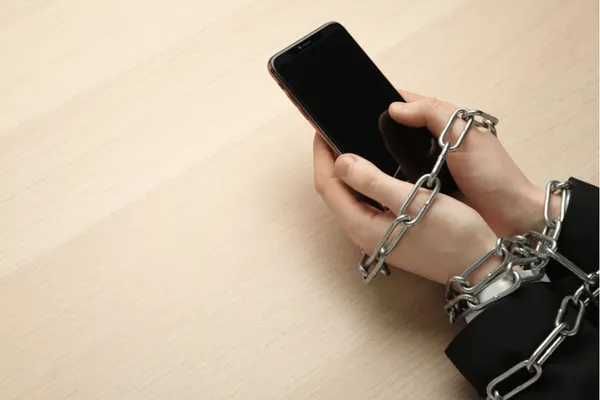


Engineered, Not Accidental
None of this happened by accident. The platforms were deliberately engineered to exploit the brain's reward circuitry: variable reinforcement schedules, infinite scroll, notification badges, the small neurological hit of a new like. The same mechanisms that make poker machines hard to walk away from were quietly embedded into apps used by billions of people, including children.
The cigarette parallel is uncomfortable but accurate. Most heavy users know, on some level, that the relationship has gotten out of hand. They've told themselves they'll cut back. They've deleted the app and reinstalled it three days later. They've set screen time limits and then tapped "ignore limit" without missing a beat. The guilt and the compulsion coexist, which is a reliable sign that something beyond simple habit is operating.
The most telling proof of what these platforms actually are comes not from medical research but from the people who built them. Former Facebook president Sean Parker stated publicly in 2017 that the platform was designed to consume as much of your time and attention as possible, exploiting a vulnerability in human psychology. Former executive Chamath Palihapitiya told a Stanford audience he has "tremendous guilt" about his role in building it and that his own children are not allowed anywhere near it. Steve Jobs limited his kids' technology use at home. Bill Gates didn't give his children smartphones until age 14. Peter Thiel limits his young children to ninety minutes of screen time per week, a number that prompted audible gasps from a live audience when he said it.
Drug dealers, as a rule, don't use their own product. The people who built the attention economy have largely made the same calculation for their own families, while the rest of us keep scrolling.
The Overload Becomes Avoidance
Here's a normal Tuesday in 2026. Texts arriving on two different threads before you've even had a coffee. A Facebook notification about something you don't remember engaging with. Seven unread emails, two of which might be urgent. Four Instagram DMs. A WhatsApp group that hasn't stopped since last Thursday, plus eight more personal messages. A missed call and voicemail you've been meaning to return since the weekend.
Each one is a ball in the air. At a certain point the brain stops trying to catch them and just watches them fall.
What gets labelled as rudeness or indifference is often something closer to a system under unsustainable load. The avoidance isn't personal; it's the path of least resistance when every channel is simultaneously demanding something. Responding to one message means confronting the seventeen behind it. So the brain does what overtaxed systems do: it defers, delays, and ultimately goes quiet.
Researchers have given this specific behaviour a name: phubbing, short for phone snubbing. It describes what happens when someone checks their device mid-conversation, choosing the screen over the person sitting next to them. A 2015 study found that phubbing isn't a standalone habit; it's the visible surface of multiple compulsions operating simultaneously, including mobile phone addiction, SMS addiction, social media addiction, and internet addiction.[1] The person staring at their phone while you're talking to them isn't simply being rude. They're caught in a web the device has quietly weaved over months or years.
And the urge has a specific psychological driver. A 2024 systematic review and meta-analysis drawing on 27 studies and more than 20,000 participants across 15 countries found a positive association between phubbing behaviour and fear of missing out.[2] The compulsion to check isn't random; it's anxiety. A genuine, measurable fear that something important is happening somewhere else right now. Which is, of course, precisely the feeling the platforms were engineered to produce and sustain.
Then there's the emotional dimension that rarely gets discussed. Within the space of four minutes you can go from laughing at a ridiculous animal video to feeling genuine rage at a political story to getting unexpectedly sentimental about a song you haven't heard since 2003. The human brain was not designed to process that emotional range in rapid succession, repeatedly, across an entire day, every single day. The cumulative effect is a kind of psychic exhaustion that has no clean name but that most people recognise immediately when it's described.
The voicemail situation is its own specific phenomenon. There are people who, when they call someone and hear it ring, feel relief when it goes to voicemail. Not because they don't want to connect, but because a voicemail is finite. A conversation is not. The call that was supposed to take five minutes has a way of taking forty-five. And forty-five minutes is a lot of balls dropping.
What gets labelled as rudeness or indifference is often something closer to a system under unsustainable load.
When I Had to Save Myself From Myself
About eighteen months ago I reached a point where I had to do something I'm not sure I'd heard of anyone else doing. I bought a second phone.
Not a fancy one. A clunky $150 cheapie from an office supplies store. I moved my old number onto it and got a new number for the main phone, one that only a handful of the more important people in my life have. The old phone sits in another room. I check it periodically. The new phone handles the things that actually require my attention.
What pushed me there was the slow realisation that the phone had invaded my headspace far more deeply than I'd consciously registered, which is exactly how it was designed to work. Because the phone wasn't just a communication device anymore. It was where I paid for groceries, checked the weather, recorded voice notes, paid bills, bought train tickets, handled email, watched shows, and searched for anything I needed to know at any given moment. It had made itself essential to the infrastructure of daily life, and in doing so it had made itself impossible to put down without feeling like I was somehow falling behind. The pattern I kept catching myself in: pick up the phone with a specific purpose, put it down twenty to thirty minutes later having done something else entirely. The original purpose, forgotten. The time, gone. And the particular kind of mental fatigue that follows isn't like physical tiredness. It's more like trying to think through molasses.
The two-phone system was, in the most literal sense, saving me from myself (not to mention the number received a dozen spam calls every day). Cold turkey, almost overnight. And the change was not subtle. Productivity up. Mental equilibrium restored. The background noise that I stopped noticing because it had become constant: quieter.
I'm not suggesting everyone needs two phones. But most people, if they're honest, recognise the pattern. The question is whether they've hit the point of doing something about it.
Don't Take It Personally
If someone isn't returning your calls, the instinct is to make it mean something about you. You might be left thinking you're not a priority. The relationship has quietly downgraded. Or they've moved on and haven't found a polite way to say so.
Before you land there, consider what the research actually shows. A 2017 study found that the mere presence of a smartphone on a desk, face down, silent, untouched, measurably reduced the cognitive capacity of people sitting near it.[3] The brain is already partially occupied just knowing the phone is there. Multiply that by the full load of a hyperconnected day and what you're dealing with is a person who is genuinely cognitively depleted before they've even started on the thing you need from them.
This is the part that's hard to internalise because it doesn't feel like an explanation. It feels like an excuse. But there's a meaningful difference between the two. An explanation describes a mechanism. An excuse asks you to accept the outcome indefinitely. Understanding why someone is unreachable doesn't mean you have to be fine with it. It just means the story you tell yourself about what it means is probably misguided.
The person who hasn't replied isn't, in most cases, sitting somewhere thinking about how little you matter to them. They're most likely swimming against the same current, caught in the same net, dealing with the same overload, and fighting the same losing battle with the same set of apps that were engineered by very smart people to make sure nobody ever fully surfaces.
Everyone is running depleted, and not in a metaphorical way. It's a measurable cognitive state, and it's become the default condition of a modern connected life.
But It's Not a Free Pass
Acknowledging the system doesn't dissolve personal responsibility. These two things can coexist without contradiction.
The platforms are designed and engineered to fragment attention and manufacture avoidance. That's true. It's also true that the people in your life who need you to show up are bearing a real cost when you don't. A 2020 study found that being on the receiving end of phubbing was associated with higher anxiety, depression, hostility, and negative self-perception, alongside meaningfully lower life satisfaction.[4] Being ignored in favour of a screen doesn't just sting in the moment. Over time, the research suggests, it does measurable psychological damage to the person being ignored.
Parental phubbing can have serious consequences on children. A 2023 meta-analysis synthesising 42 studies and more than 56,000 children found that parents using phones in their children's presence instead of engaging with them was associated with increased behavioural problems, lower self-concept, and reduced social-emotional competence.[5] When both parents phubbed, the effects were stronger than when only one did. The phone isn't just pulling adults away from each other; it's pulling parents out of their children's development during the years when presence is irreplaceable.
The elderly parent who has genuinely started to wonder. The friend going through something serious who sent one message and then went quiet because no response felt like an answer. The colleague who needed a ten-minute conversation two weeks ago and has since made a decision without you. Knowing the system is broken doesn't mean you get to stop being a person inside it. What it does mean is that showing up intentionally, in a world designed to prevent exactly that, has become an act requiring actual effort. It used to be the default. It isn't anymore.
The Question Nobody's Asking
We've built the most sophisticated communication infrastructure in human history and, quite ironically, used it to become harder to reach. There's something almost impressive about that as an achievement, if you step back and consider it.
The tools aren't going anywhere. The load isn't getting lighter. But somewhere underneath all of it is the same thing that made someone pick up a telephone in the first place: the need to actually connect with another person, not performative connection through a screen.
Whether we still remember how to do that is a question worth pondering. Probably not on your phone.
References
- Karadağ E, Tosuntaş ŞB, Erzen E, Duru P, Bostan N, Şahin BM, Çulha İ, Babadağ B. Determinants of phubbing, which is the sum of many virtual addictions: a structural equation model. J Behav Addict. 2015;4(2):60-74. https://doi.org/10.1556/2006.4.2015.005
- Ansari S, Azeem A, Khan I, Iqbal N. Association of Phubbing Behavior and Fear of Missing Out: A Systematic Review and Meta-Analysis. Cyberpsychol Behav Soc Netw. 2024;27(7):467-481. https://doi.org/10.1089/cyber.2023.0761
- Ward AF, Duke K, Gneezy A, Bos MW. Brain Drain: The Mere Presence of One's Own Smartphone Reduces Available Cognitive Capacity. Journal of the Association for Consumer Research. 2017;2(2):140-154. https://www.journals.uchicago.edu/doi/10.1086/691462
- Ergün N, Göksu İ, Sakız H. Effects of Phubbing: Relationships With Psychodemographic Variables. Psychol Rep. 2020;123(5):1578-1613. https://doi.org/10.1177/0033294119889581
- Zhang J, Dong C, Jiang Y, Zhang Q, Li H, Li Y. Parental Phubbing and Child Social-Emotional Adjustment: A Meta-Analysis of Studies Conducted in China. Psychol Res Behav Manag. 2023;16:4267-4285. https://doi.org/10.2147/PRBM.S417718
- Run Interactive ToolsAddicted to your smartphone? Take the test!Read more →
- Rewire My BrainGeneration A: Unplugging the Social Media Addiction EpidemicRead more →
- Reframe My ThoughtsTrapped by Your Own Success? The High Achiever's Guide to Cognitive DistortionsRead more →
- Rewire My BrainDeclutter Your Mind in 10 Steps for Clarity and FocusRead more →
